APRIL 15, 2019
PATRIOTS’ DAY
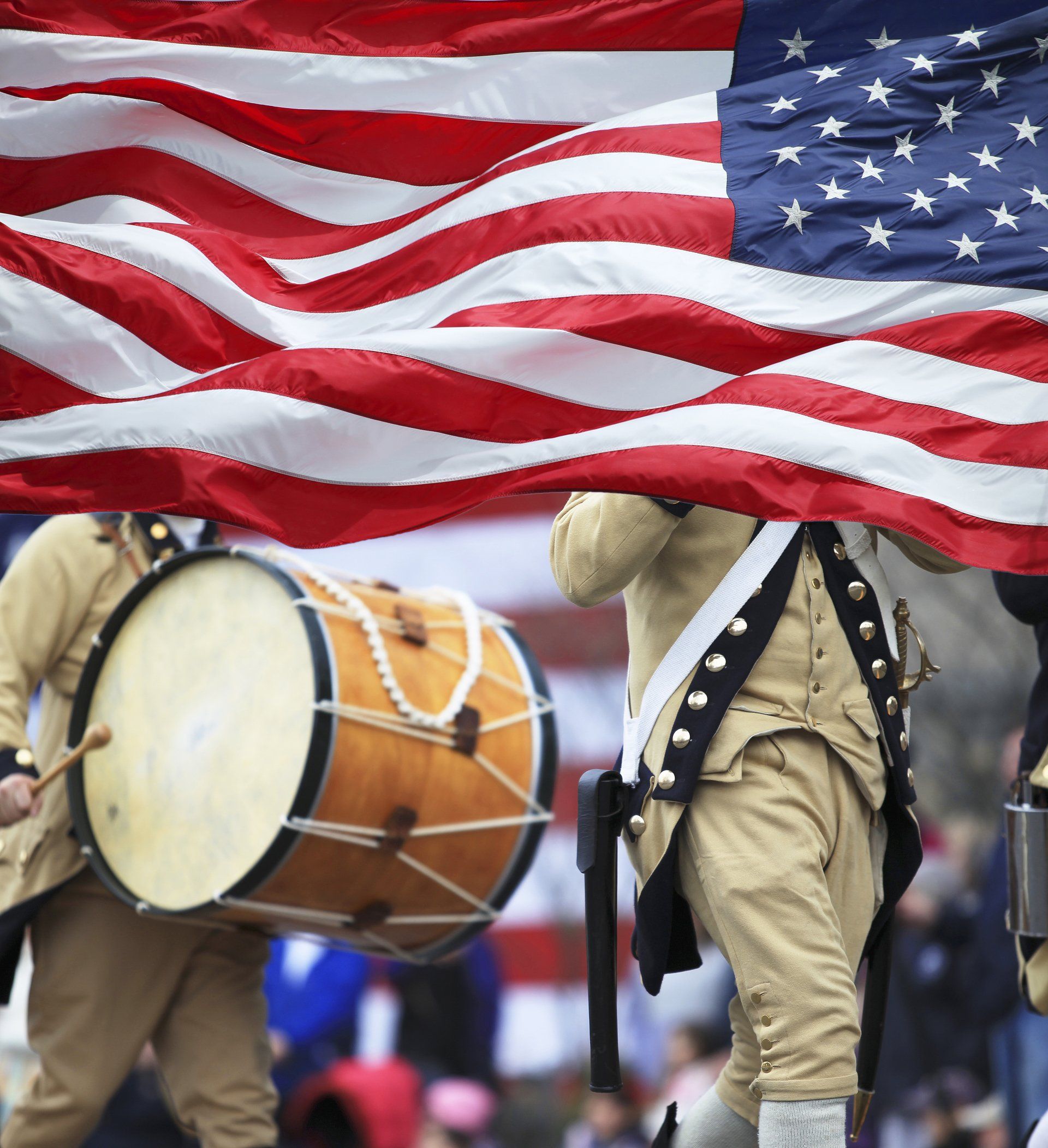
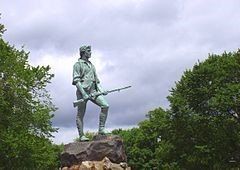
The story of Lexington and Concord began when the British made plans to seize a stash of Patriot munitions stored in Lexington. The plan was discovered, and Paul Revere made his “immortal” ride to warn of the dastardly plot. Minute men sprang into action to oppose the British soldiers marching down the road.
There was a standoff that finally resulted in the mysterious “shot heard round the world,” which no one knows who fired, that began the American Revolution. Americans fought a hit and run style action against the British at Lexington and Concord and successfully moved the munitions to another, safer, location.
In Massachusetts and Maine, Patriots’ Day is basically a day off work for adults and out of school for kids. But in the towns of Lexington and Concord, reenactments of the battles fought there long ago are held every year. Those who come to see the reenactments also can ring the warning bell that warned the British were coming and attend seminars, concerts, races, and other special events. We strongly encourage you to attend these glorious events on Patriots’Day, and bring your children so that they will learn some valuable and incredible history.
Of course, we are blessed to have someone put to life the actions of one we consider to be an Original Founding Father, Paul Revere. Without him warning all the people that the British were coming, who knows what would have happened to the Patriots and Minutemen of the day back in 1775? So, we present to you Mr Henry Wadsworth Longfellow’s poem of Paul Revere.
Paul Revere's Ride
From Wikipedia, the free encyclopedia:
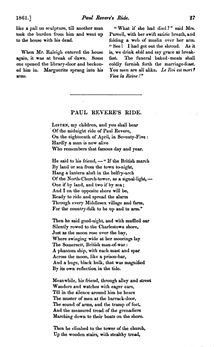
"Paul Revere's Ride" was first published in The Atlantic Monthly in 1861.
" Paul Revere's Ride " (1860) is a poem by American poet Henry Wadsworth Longfellow that commemorates the actions of American patriot Paul Revere on April 18, 1775, although with significant inaccuracies. It was first published in the January 1861 issue of The Atlantic Monthly . It was later retitled " The Landlord's Tale " in the collection Tales of a Wayside Inn .
Listen
my children and you shall hear
Of the midnight ride of Paul Revere,
On the eighteenth of April, in Seventy-five;
Hardly a man is now alive
Who remembers that famous day and year.
He
said to his friend, "If the British march
By land or sea from the town to-night,
Hang a lantern aloft in the belfry arch
Of the North Church tower as a signal light,--
One if by land, and two if by sea;
And I on the opposite shore will be,
Ready to ride and spread the alarm
Through every Middlesex village and farm,
For the country folk to be up and to arm."
Then
he said "Good-night!" and with muffled oar
Silently rowed to the Charlestown shore,
Just as the moon rose over the bay,
Where swinging wide at her moorings lay
The Somerset, British man-of-war;
A phantom ship, with each mast and spar
Across the moon like a prison bar,
And a huge black hulk, that was magnified
By its own reflection in the tide.
Meanwhile,
his friend through alley and street
Wanders and watches, with eager ears,
Till in the silence around him he hears
The muster of men at the barrack door,
The sound of arms, and the tramp of feet,
And the measured tread of the grenadiers,
Marching down to their boats on the shore.
Then
he climbed the tower of the Old North Church,
By the wooden stairs, with stealthy tread,
To the belfry chamber overhead,
And startled the pigeons from their perch
On the sombre rafters, that round him made
Masses and moving shapes of shade,--
By the trembling ladder, steep and tall,
To the highest window in the wall,
Where he paused to listen and look down
A moment on the roofs of the town
And the moonlight flowing over all.
Beneath,
in the churchyard, lay the dead,
In their night encampment on the hill,
Wrapped in silence so deep and still
That he could hear, like a sentinel's tread,
The watchful night-wind, as it went
Creeping along from tent to tent,
And seeming to whisper, "All is well!"
A moment only he feels the spell
Of the place and the hour, and the secret dread
Of the lonely belfry and the dead;
For suddenly all his thoughts are bent
On a shadowy something far away,
Where the river widens to meet the bay,--
A line of black that bends and floats
On the rising tide like a bridge of boats.
Meanwhile,
impatient to mount and ride,
Booted and spurred, with a heavy stride
On the opposite shore walked Paul Revere.
Now he patted his horse's side,
Now he gazed at the landscape far and near,
Then, impetuous, stamped the earth,
And turned and tightened his saddle girth;
But mostly he watched with eager search
The belfry tower of the Old North Church,
As it rose above the graves on the hill,
Lonely and spectral and sombre and still.
And lo! as he looks, on the belfry's height
A glimmer, and then a gleam of light!
He springs to the saddle, the bridle he turns,
But lingers and gazes, till full on his sight
A second lamp in the belfry burns.
A
hurry of hoofs in a village street,
A shape in the moonlight, a bulk in the dark,
And beneath, from the pebbles, in passing, a spark
Struck out by a steed flying fearless and fleet;
That was all! And yet, through the gloom and the light,
The fate of a nation was riding that night;
And the spark struck out by that steed, in his flight,
Kindled the land into flame with its heat.
He has left the village and mounted the steep,
And beneath him, tranquil and broad and deep,
Is the Mystic, meeting the ocean tides;
And under the alders that skirt its edge,
Now soft on the sand, now loud on the ledge,
Is heard the tramp of his steed as he rides.
It
was twelve by the village clock
When he crossed the bridge into Medford town.
He heard the crowing of the cock,
And the barking of the farmer's dog,
And felt the damp of the river fog,
That rises after the sun goes down.
It
was one by the village clock,
When he galloped into Lexington.
He saw the gilded weathercock
Swim in the moonlight as he passed,
And the meeting-house windows, black and bare,
Gaze at him with a spectral glare,
As if they already stood aghast
At the bloody work they would look upon.
It
was two by the village clock,
When he came to the bridge in Concord town.
He heard the bleating of the flock,
And the twitter of birds among the trees,
And felt the breath of the morning breeze
Blowing over the meadow brown.
And one was safe and asleep in his bed
Who at the bridge would be first to fall,
Who that day would be lying dead,
Pierced by a British musket ball.
You
know the rest. In the books you have read
How the British Regulars fired and fled,---
How the farmers gave them ball for ball,
From behind each fence and farmyard wall,
Chasing the redcoats down the lane,
Then crossing the fields to emerge again
Under the trees at the turn of the road,
And only pausing to fire and load.
So
through the night rode Paul Revere;
And so through the night went his cry of alarm
To every Middlesex village and farm,---
A cry of defiance, and not of fear,
A voice in the darkness, a knock at the door,
And a word that shall echo for evermore!
For, borne on the night-wind of the Past,
Through all our history, to the last,
In the hour of darkness and peril and need,
The people will waken and listen to hear
The hurrying hoof-beats of that steed,
And the midnight message of Paul Revere.
Overview
The poem is spoken by the landlord of the Wayside Inn and tells a partly fictionalized story of Paul Revere. In the poem, Revere tells a friend to prepare signal lanterns in the Old North Church( North End, Boston) to inform him whether the British will attack by land or sea. He would await the signal across the river in Charlestown and be ready to spread the alarm throughout Middlesex County, Massachusetts. The unnamed friend climbs up the steeple and soon sets up two signal lanterns, informing Revere that the British are coming by sea. Revere rides his horse through Medford, Lexington, and Concord to warn the patriots.
Composition and Publication History
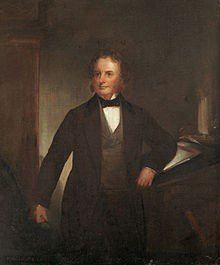
Henry Wadsworth Longfellow in 1860, the year he wrote "Paul Revere's Ride", painted by Thomas Buchanan Read
Longfellow was inspired to write the poem after visiting the Old North Church and climbing its tower on April 5, 1860. He began writing the poem the next day. It was first published in the January 1861 issue of The Atlantic Monthly . It was later re-published in Longfellow's Tales of a Wayside Inn as "The Landlord's Tale" in 1863. The poem served as the first in a series of 22 narratives bundled as a collection, similar to Geoffrey Chaucer's The Canterbury Tales , and was published in three installments over 10 years.
Longfellow's family had a connection to the historical Paul Revere. His maternal grandfather, Peleg Wadsworth, was Revere's commander on the Penobscot Expedition.
Analysis
When the poem was written in 1860, America was on the verge of Civil War. Longfellow first came forward publicly as an abolitionist in 1842 with the publication of his Poems on Slavery . Though he admitted the book made little impact, it was written for his best friend, Charles Sumner, an activist abolitionist politician with whom he would continue to share common cause on the issues of slavery and the Union. "Paul Revere's Ride" was published in the January 1861, issue of The Atlantic magazine on December 20, 1860, just as South Carolina became the first state to secede from the United States. The poem was meant to appeal to Northerners' sense of urgency and, as a call for action, noted that history favors the courageous. Longfellow, who often used poetry to remind readers of cultural and moral values, warns at the end of the poem of a coming "hour of darkness and peril and need", implying the breakup of the Union, and suggests that the "people will waken and listen to hear" the midnight message again. By emphasizing common history, he was attempting to dissolve social tensions.
The phrase "Hardly a man is now alive" was true as one of the last men alive at the time had only recently died. Jonathan Harrington, the young fifer for Lexington's militia during the battles of Lexington and Concord, died at the age of 96 in 1854, a few years before the poem was written. The poem fluctuates between past and present tense, sometimes in the same sentence, symbolically pulling the actions of the Revolution into modern times and displaying an event with timeless sympathies.
Longfellow's poem is not historically accurate but his "mistakes" were deliberate. He had researched the historical event, using works like George Bancroft's History of the United States , but he manipulated the facts for poetic effect. He was purposefully trying to create American legends, much as he did with works like The Song of Hiawatha (1855) and The Courtship of Miles Standish (1858).
Critical Response
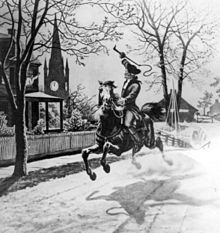
Modern critics of the poem emphasize its many historical inaccuracies. For example, the poem depicts the lantern signal in the Old North Church as meant for Revere, but actually the signal was from Revere: the historical Paul Revere did not receive the lantern signal, but actually was the one who ordered it to be set up. The poem also depicts Revere rowing himself across the Charles River when, in reality, he was rowed over by others. He also did not reach Concord that night. Another inaccuracy is a general lengthening of the time frame of the night's events.
The majority of criticism, however, notes that Longfellow gave sole credit to Revere for the collective achievements of three riders (as well as other riders, whose names do not survive to history). In fact, Revere and William Dawes rode (via different routes) from Boston to Lexington to warn John Hancock and Samuel Adams that British soldiers were marching from Boston to Lexington to arrest Hancock and Adams and seize the weapons stores in Concord. Revere and Dawes rode toward Concord, where the militia's arsenal was hidden; they were joined by Samuel Prescott, a doctor who lived in Concord and happened to be in Lexington. Revere, Dawes, and Prescott were stopped by British troops in Lincoln on the road to Concord. Prescott and Dawes escaped, but Revere was detained and questioned and then escorted at gunpoint by three British officers back to Lexington. Of the three riders, only Prescott arrived at Concord in time to warn the militia thereHistorical Impact
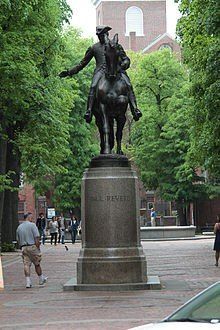
Paul Revere (1940) by Cyrus Edwin Dallin, North End, Boston, Massachusetts. The Old North Church is visible in the background.
Longfellow's poem is credited with creating the national legend of Paul Revere, a previously little-known Massachusetts silversmith. Upon Revere's death in 1818, for example, his obituary did not mention his midnight ride but instead focused on his business sense and his many friends. The fame that Longfellow brought to Revere, however, did not materialize until after the Civil War amidst the Colonial Revival Movement of the 1870s. In 1875, for example, the Old North Church mentioned in the poem began an annual custom called the "lantern ceremony" recreating the action of the poem. Three years later, the Church added a plaque noting it as the site of "the signal lanterns of Paul Revere". Revere's elevated historical importance also led to unsubstantiated rumors that he made a set of false teeth for George Washington. Revere's legendary status continued for decades and, in part due to Longfellow's poem, authentic silverware made by Revere commanded high prices. Wall Street tycoon J. P. Morgan, for example, offered $100,000 for a punch bowl Revere made.
In 1883, Boston held a national competition for an equestrian statue of Revere. It was won by Cyrus Edwin Dallin, although his model was not accepted until 1899, and the statue was not dedicated until 1940. It stands in "Paul Revere Plaza," opposite the Old North Church.
In 1896 Helen F. Moore, dismayed that William Dawes had been forgotten, penned a parody of Longfellow's poem:
'Tis all very well for the children to hear
Of the midnight ride of Paul Revere;
But why should my name be quite forgot,
Who rode as boldly and well, God wot?
Why should I ask? The reason is clear—
My name was Dawes and his Revere.
For a long time, historians of the American Revolution as well as textbook writers relied almost entirely on Longfellow's poem as historical evidence – creating substantial misconceptions in the minds of the American people. In re-examining the episode, some historians in the 20th century have attempted to demythologize Paul Revere almost to the point of marginalization. While it is true that Revere was not the only rider that night, that does not refute the fact that Revere successfully completed the first phase of his mission to warn Adams and Hancock. Other historians have since stressed Revere's importance, including David Hackett Fischer in his book Paul Revere's Ride (1995), a scholarly study of Revere's role in the opening of the Revolution.
In 2007, the United States Postal Service (USPS) issued a commemorative stamp with images referencing the poem. Longfellow is represented by a painting by artist Kazuhiko Sano.
Henry Wadsworth Longfellow
1807-1882 , Portland , ME
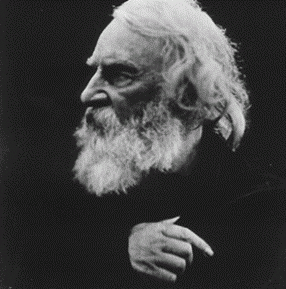
Henry Wadsworth Longfellow was born in Portland, Maine—then still part of Massachusetts—on February 27, 1807, the second son in a family of eight children. His mother, Zilpah Wadsworth, was the daughter of a Revolutionary War hero. His father, Stephen Longfellow, was a prominent Portland lawyer and later a member of Congress.
After graduating from Bowdoin College, Longfellow studied modern languages in Europe for three years, then returned to Bowdoin to teach them. In 1831 he married Mary Storer Potter of Portland, a former classmate, and soon published his first book, a description of his travels called Outre Mer (“Overseas”). But in November 1835, during a second trip to Europe, Longfellow’s life was shaken when his wife died during a miscarriage. The young teacher spent a grief-stricken year in Germany and Switzerland.
Longfellow took a position at Harvard in 1836. Three years later, at the age of thirty-two, he published his first collection of poems, Voices of the Night, followed in 1841 by Ballads and Other Poems . Many of these poems (“A Psalm of Life," for example) showed people triumphing over adversity, and in a struggling young nation that theme was inspiring. Both books were very popular, but Longfellow’s growing duties as a professor left him little time to write more. In addition, Frances Appleton, a young woman from Boston, had refused his proposal of marriage.
Frances finally accepted his proposal the following spring, ushering in the happiest eighteen years of Longfellow’s life. The couple had six children, five of whom lived to adulthood, and the marriage gave him new confidence. In 1847, he published Evangeline, a book-length poem about what would now be called “ethnic cleansing.” The poem takes place as the British drive the French from Nova Scotia, and two lovers are parted, only to find each other years later when the man is about to die.
In 1854, Longfellow decided to quit teaching to devote all his time to poetry. He published Hiawatha, a long poem about Native American life, and The Courtship of Miles Standish and Other Poems . Both books were immensely successful, but Longfellow was now preoccupied with national events. With the country moving toward civil war, he wrote "Paul Revere’s Ride," a call for courage in the coming conflict.
A few months after the war began in 1861, Frances Longfellow was sealing an envelope with wax when her dress caught fire. Despite her husband’s desperate attempts to save her, she died the next day. Profoundly saddened, Longfellow published nothing for the next two years. He found comfort in his family and in reading Dante’s Divine Comedy . (Later, he produced its first American translation.) Tales of a Wayside Inn, largely written before his wife’s death, was published in 1863.
When the Civil War ended in 1865, the poet was fifty-eight. His most important work was finished, but his fame kept growing. In London alone, twenty-four different companies were publishing his work. His poems were popular throughout the English-speaking world, and they were widely translated, making him the most famous American of his day. His admirers included Abraham Lincoln, Charles Dickens, and Charles Baudelaire.
From 1866 to 1880, Longfellow published seven more books of poetry, and his seventy-fifth birthday in 1882 was celebrated across the country. But his health was failing, and he died the following month, on March 24. When Walt Whitman heard of the poet’s death, he wrote that, while Longfellow’s work “brings nothing offensive or new, does not deal hard blows," he was the sort of bard most needed in a materialistic age: “He comes as the poet of melancholy, courtesy, deference—poet of all sympathetic gentleness—and universal poet of women and young people. I should have to think long if I were ask’d to name the man who has done more and in more valuable directions, for America.”